Network with Malaysian Parents
Showing posts with label Finance. Show all posts

Thursday, March 15, 2018

Choosing The Right Savings Account For Your Children - Part 2


This is part 2 of a guest post by Joanne Lee who also wrote the very popular post on The Importance of Penmanship in SJKC. The post below was written due to her own research on what 10 different banks have to offer in terms of savings accounts for children. Thank you, Joanne for your time in doing this research and putting it down in writing to share with all of us on the Malaysia Primary School Parents On Facebook.


If you haven’t read Part 1 where we compared interest rates of 13 different junior savings accounts, do check that one out first before continuing with this post. Go ahead, we’ll wait.

Back for Part 2 already? Let’s dive in.

What you need to know: Dormant accounts are bad for business!

It is important that you do not let your junior savings accounts go dormant. Going dormant means going through 12 months of no transactions (deposits or withdrawals) at all.

Most banks will make an attempt to send mail to your registered mailing address or to call you and inform you about this before it happens, provided you keep your contact details updated.

Once a bank account goes dormant, the money will still be in there, but banks will start charging a RM10 service fee for keeping your money with them.

This is chargeable annually, which means for every year your account is dormant, not only do you not reap any interest, you also get RM10.60 (GST 6%) deducted from your account (per year).

They will do this for 7 years before they send the remaining money to Bank Negara. You can still claim that money back but the bank will be of no part of the process -- even though, they had already taken RM74.20 (RM10.60 x 7) out of it first.

To reactivate your account, just bring your passbook and identification documents to your bank and ask for the account to be reactivated. There will be a penalty fee of RM10, but at least your account will be gathering interest instead of making losses from there on.

Apart from withdrawal fees and dormant account fees, there is another fee you should be aware of. If you have just recently opened a bank account and decided you want to switch your savings to another account, hold your horses because there are early closure fees.

These range between 3 months to 6 months, dependent on the bank. The fees will be no more than RM20, plus the RM1.20 GST. Before you make any move, wait out the stipulated period to avoid paying these fees.

Table 3 Early Closure fees and Dormant fees


Early Closure fees and Dormant fees


What you should know: Don’t ignore the game changers

You can call these gimmicks if you like but if it is there in black and white, you can always lay claim on these benefits if the chance pops up.

There are monetary rewards for the studious (requires a minimum balance in the account maintained in the year leading up to the submission, personal accident coverage (which is dependent on your balance, and always has a maximum amount you can claim), a point scoring system for redeeming goods, etc.

If you want to provide your teenager with some financial freedom, some of these products come with ATM cards, easy-to-reload debit cards, an online monitoring system so parents can track their kid’s spending, or a spending limit if teens prefer to have some privacy with their spending habits, and other features that can help you teach your kids financial literacy.

Table 4 Other offerings by the same junior savings products

Other offerings by the same junior savings products


What you should know: Don’t overlook FD as an alternative.

This particular section is for those who want to save for the long term and have no plans to withdraw money from their children’s savings. In this case, it is possible that a fixed deposit is a better option for your savings, compared to a junior savings account that comes with a lot of strings.

But before that...

Understanding Fixed Deposits


As the defining thing about Fixed Deposits is that they are fixed, once you put in the money, you can’t remove it until the end of the period you signed up for.

These periods could range from 1 month all the way to 12 months (1 year) and even up to 60 months (5 years). If you take it out before the FD matures (reach the end of the period or tenure), you forfeit the interest, either fully or by half, depending on the bank’s TnC.

As for the interest, you have the option to reinvest the interest or to shift it into a savings account where you can withdraw it for use.

For 1-month FD, most banks require at least RM5000 as an initial deposit. If you go for 2 months or more, this can drop to RM1000 or RM500. 

Alright, with that out of the way, let’s take a look at which banks offer better FD rates than their junior savings. 

Notes:
  1. For easier comparison, I’m picking the basic FD product instead of listing all the different products banks are offering now (for working adults, for elderly etc) 
  2. For brevity, I will be listing 1 month rates, 12 month rates and 60 month rates. 
  3. To know the exact rate for tenures apart from these three, please check at the bank or their websites.
  4. A lot of the withdrawal options are gleaned from the Terms and Conditions attached to the products.

Table 5 FD rates vs Junior Savings rates

FD rates vs Junior Savings rates


**Withdrawal notes: 
  1. For 1-month, 2-months and 3-months FD, withdrawal before maturity automatically forfeits the interest.
  2. For tenures longer than 3 months, any withdrawal before the first 3 months is up also forfeits the interest.
  3. For longer tenures (for some banks 6 months, other banks 12 months), premature withdrawal will incur a loss of half the FD rate. This means you only get half of the FD rate x completed months.

Lastly, keep an eye out for promotional FD rates around Chinese New Year. Some banks offer rates of more than 4% e.g. HLB had a recent promotional 4.35% rate, while OCBC offers a 4.38% rate and Ambank offered a 4.03%. If you missed it this year, keep an eye out for it next year.

Note that these promotions require a higher deposit amount, usually RM10,000 as well as a 12-month FD commitment (although some can go for as short as 8 months only, check out Ambank for deals like this).

Conclusion

Phew, so there you have it. We hope this post will make it easier for you to make decisions and more importantly, it will open your eyes to how these bank products function. If you are in any doubt, please do not hesitate to speak to your banks before, not after, you sign up for any bank products.

If you want to look at a table that has all the information above grouped together, follow this link.

It has been suggested to me that I cover other investment options (unit trust, REITs, insurance, educational bonds) outside of junior savings. Whether this article will happen or not depends on your response to this post. Do let us know either way.

Final note: I’d like to thank Peachie Berry, KJB and other parents for their help in this article.

Disclaimers:
  1. The information above is not exhaustive. 
  2. Information inside may be changed down the road by the banks and their changes may not be reflected on this article. There is however an easy remedy to this -- ask your bank for details and confirmation before you sign up for anything.
  3. I am not trained financially or in legal speak. My interpretations of the terms and conditions as well as the information portrayed on the bank websites are only to the best of my abilities as a layperson. In my defence, the terms should be written with us, the laypersons, in mind.

Wednesday, March 14, 2018

Choosing The Right Savings Account For Your Children - Part 1

This guest post came about because of the discussion that was raised in our Facebook group: The Malaysia Primary School Parents On Facebook. We really appreciate active members who share generously like Joanne Lee who also wrote the very popular post on The Importance of Penmanship in SJKC. The post below was written due to her own research on what 10 different banks have to offer in terms of savings accounts for children. Thank you, Joanne for doing the research on behalf of parents who enquired.


As parents, we can’t help but worry about our children’s education and future. That’s why some of us started saving for our kids from the day they were born.

The obvious choice for most is a junior savings account. This refers to special bank products that are aimed at savers below the age of 18. These accounts enjoy higher interest rates, some as high as fixed deposit (FD) rates, but unlike FD you can still withdraw from these junior savings accounts.

That said, not all junior savings are created equal.

After a few parents started a discussion about which bank offers the best junior savings, I went through all the pros and cons, benefits and conditions of kids savings bank accounts offered by 10 different banks.

What started out as a fact-finding mission just to answer a few questions turned into a full-fledged research project. So if you’re looking for an answer to the question, “Which is the best bank for my children to open a savings account?”, this is the post for you.


What To Look Out For

If you are looking for the interest rates for comparison, I have grouped them all together in a table for easy viewing.

There are 13 products from 9 banks listed. I chose these due to their competitive rates. There are other banks out there but putting them into this table makes the comparison a bit lopsided.

You will be able to see info such as age eligibility, initial deposit required as well as the multi-tiered rates that are dependent on the balance in the account.

Note! These are the rates that turn up during the research for this article. By the time you read this, it is possible that the figures have been changed by the banks. Before you make any financial decisions, please take the time to check with your bank for their most updated and current rates.


Table 1 Interest rates of Junior Savings Bank Accounts

Interest rates of Junior Savings Bank Accounts

What You Need To Know: Junior savings products have much higher interest rates compared to what adult savings products get.

If you don’t already know, regular savings bank accounts have pitiful interest rates, hovering around 0.3 to 0.6% at best.

As you can see in Table 1, junior savings bank accounts offer 10 times the interest rate of their adult counterparts. If you’re not under the age of 18, the only way you can see those rates is if you put your money in FD, or if you put in a large amount.

If you are below the age of 18, most of these banks (bar 2 exceptions) are available to you. Some require as little as RM1 as an initial deposit; the highest amount is RM500 for OCBC Young Savers.

The age requirement is something important to take note of a good 10, 15 years from now, Because the moment the account holder turns 18, their junior savings account will be converted into conventional savings and their interest rates will drop to measly figures.

As a reminder, interest rates will change from bank to bank and they may even change more than once a year per bank.

What You Need To Know: Interest rates may come with conditions

If you grab a pamphlet from the counter in any bank, you will probably see the interest rate figures printed in large fonts, and if you aren’t paying attention, you’ll probably miss out on the conditions you have to fulfill in order to “earn” those rates.

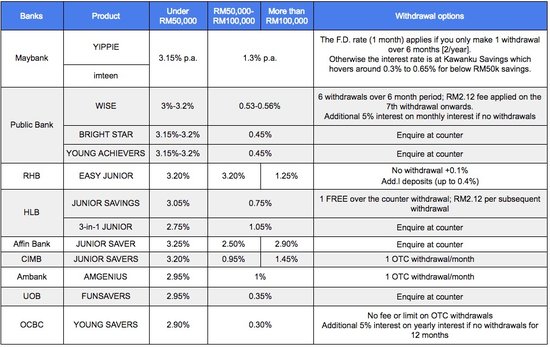
The savings amount and withdrawal options both play important roles in helping one decide the right savings account for their children. Check out the table to find out why.


Table 2 How to keep or earn the Interest rates they print on the pamphlet

How to keep or earn the Interest rates they print on the pamphlet
* Watch out for the link to the comprehensive combined comparison chart in our next post

What To Consider: The amount of savings

As you can see, the interest rates I’ve listed here are broken down into 3 columns, for savings of less than RM50,000, for savings between RM50,000 and RM100,000 and for savings beyond RM100,000.

Notice how interest rates across the board, drop tremendously past the RM50,000 mark.

If you save diligently, do it almost entirely online and thus do not update your passbook on a yearly basis, there is a possibility that one day down the line you breach the RM50,000 limit without knowing.

When that happens, you’re seeing interest that can buy you a brand new PS4 drop down to clearing one month’s electricity bill.

In this scenario, you won’t be affected much if you bank with RHB Easy Junior because it still gives you 3.2% up to RM100,000.

Affin Bank Junior Saver also gives you a relatively healthy 2.5% compared to Maybank Yippie’s 1.3%, Ambank AmGenius and HLB 3-in-1 Junior (around 1%).

The other banks drop it down to regular conventional savings rates, post-RM50,000.

If you want to ensure that you are saving effectively for your children, you need to stay on top of your all your savings and investments constantly.

What To Consider: Withdrawal conditions that affect interest rates

Now I know that parents use these banks for savings purposes, but eventually down the road when their teenagers begin learning how to better manage their money, it’s possible that they need to make periodical withdrawals from “their” accounts.

Here’s where withdrawal conditions may mess up your interest rate privileges.

For Maybank’s Yippie, you only get the 3.15% per annum if you make a single withdrawal across 6 months. That’s (2) withdrawals in a year, 6 months apart.

So if you make (3) withdrawals in a year, you are not getting your 3.15% p.a. interest rate. The same thing happens if you make two withdrawals less than 6 months apart.

If you have to make monthly withdrawals from your kid’s account, this product is not for you.

What about the other banks then? Public Bank WISE is much wiser. It gives you 6 withdrawals over a 6 month period (an average of once per month) and even if you exceed that, it just charges you a RM2.12 fee per withdrawal.

Withdrawing from this account doesn’t harm your interest rate but remember that exceeding RM50,000 does: the rate drops to around 0.56%, which is a huge drop. In comparison, Maybank’s Yippie drops to 1.3%.

By the way, I have to mention that Public Bank WISE offers you an extra 5% interest on your monthly interest if you do not make any withdrawals. While that 5% sounds like a lot, do note that it is applied on your interest, not your capital. At most, this amount is no more than RM6.50 per month.

RHB Easy Junior also has a reward (instead of a penalty) for non-withdrawals, an additional 0.1% to their already high 3.2%. Plus, if you make regular monthly deposits they give you a bit more % p.a. i.e up to 0.4% if you bank in RM1000 every month.

So theoretically, if you bank in RM1000 per month into your RHB Easy Junior, and make no withdrawals for the whole year, you are enjoying 3.7% p.a

But that’s a lot of conditions to follow and with RM1000 savings per month (RM12,000 a year), you might get better returns from other investment options.

From Table 2, you can see that a few other bank products also offer 1 over-the-counter (OTC) free withdrawal every month, with no penalties that affect the interest rate. That said, this table of info is not exhaustive. Do make your enquiries at the bank of your choice for more details.

Wrapping Up Part 1

Alright, that’s enough info to keep you busy for the moment.

But if you want more, keep an eye out for our follow up post where we look at how bad dormant accounts cut back on your earnings as well as some of the benefits offered by these junior savings accounts that might be the deal-breaker you need.

Also, we pit these junior savings accounts against their Fixed Deposit counterparts to see which is the real deal you should be banking on.

To be continued..... Part 2 here

Popular Posts